Season 2 (Spring) Episode 14: (Hocking Rock Climbing)
- Gary Thewoodsprite
- Jun 1
- 3 min read

On Today’s episode of Adventures with Gary The Wood Sprite: Season 2, (Spring) episode 14 (Hocking Rock Climbing). It’s May 30, 2026. We started at the parking lot for the Hocking Climbing and Rappelling Area in Logan, OH. From there we took the bridge trail. This was my very first-time rock climbing! Yay!
OMG. Guys! We saw so much beauty and such very high level of fairy energy. It was so transformative. I was nervous of course since this is my first time climbing, rappelling and rock scrambling.
So, the lesson for this day is: climb with a pro! Don’t do it yourself, it’s so dangerous. My lovely human guide hired the good people at Hocking Hills Adventure Trek. They are experts in both safety and fun.
How to tell apart the different areas of the Hocking region? Here is simple way to think about it: Hocking Hills = the whole tourism/natural area. Hocking Hills State Park = the main collection of famous hiking destinations. Hocking State Forest = a large surrounding forest that is part of the region but separate from the state park. Hocking State Forest and Hocking Hills State Park are adjacent and interwoven in places, but they are separately managed public lands.
An orange painted dot on a tree often indicates a tree is a "hazard tree" that is scheduled to be professionally removed to prevent it from falling on hiking trails or visitors. Same with the yellow X, that means its destined for future removal due to disease, infestation, or being a safety hazard.
We saw a group of summer azure butterflies. They have white wings on the outside and purple/blue on the inside. They are so cute.
Now you know my all-time favorite bird is the wood thrush (from S2E9), but today as I listened, I thought I heard a modified wood thrush song. Turns out it was a Hermit Thrush! Woah. It also has a glorious song. Ohio hosts 6 regular species of true thrushes (family Turdidae).
The steep cliffs and boulders were so vertical it gave me vertigo to try to look at it all at once. In one crevice I could hear a waterfall behind the rocks but couldn’t see it. It was like a ghost waterfall.
The biggest waterfall is the Big Spring Hollow Falls. It’s the largest in Ohio at 120 feet!
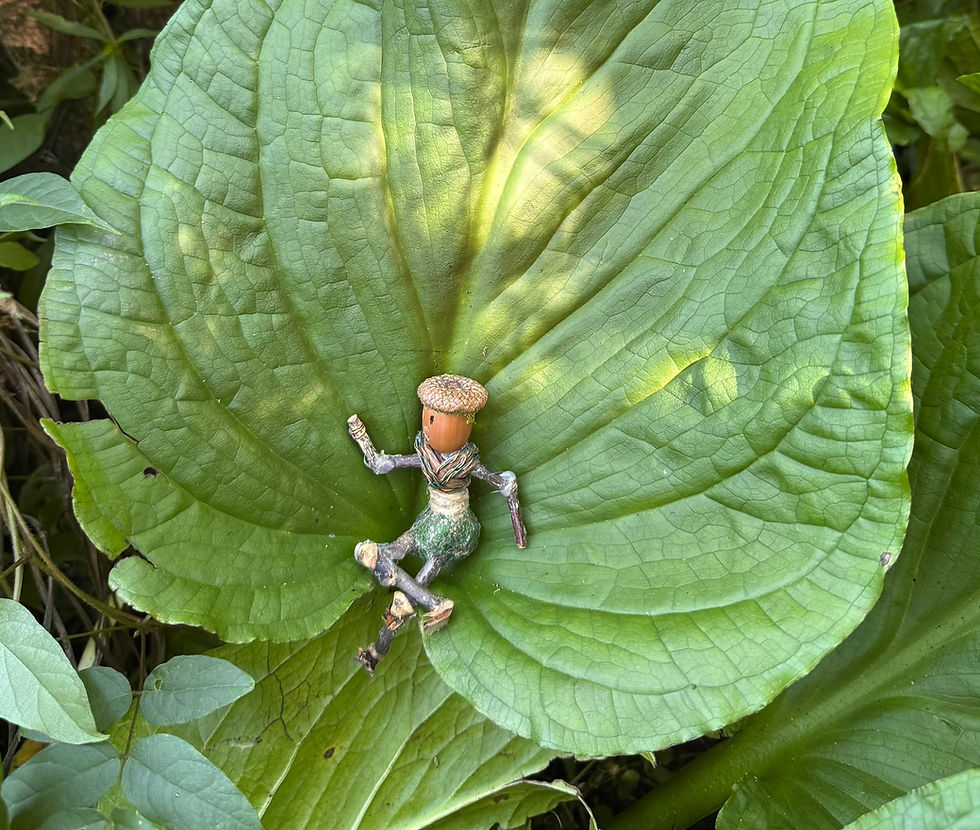
As the humans worked on setting up for a climb. I snuck out so as not to be seen and tried on the gear. Alas, it didn’t fit, but I found a piece of vine that fit me perfectly and I rappelled and climbed! What a rush. Now I know why they like it so much. The humans rappelled off the big waterfall but I couldn’t watch, too scary. This is also a place to watch out for sneaky cliffs that you can’t see over (see the cliff post from S2E4).
The trail marked by two blue rectangles (or "blue blazes") is the 1,440-mile Buckeye Trail. This statewide hiking route loops around Ohio, connecting Lake Erie in the north to the Ohio River in the south
On to the plants!
We saw: Jack-in-the-plupit (S2E4 and S2E6), Common Greenbrier, Partridge Berry, Pink Lady Slipper Orchid (rare and not in bloom, dang), Indian Cucumber, Intermediate Wood Fern, Coral mushroom, and several other mushrooms (someday I will become a mushroom expert, I keep telling myself that), white oak, eastern red cedar, lots of pincushion moss and gorgeous lichen, a beech tree with romance carvings of course (see S2E9 with Karen and Mike)
We also saw American cancer-root. I am so impressed that I found it accidently. It’s in the picture that looks like tall skinny pinecones. It’s is a leafless, parasitic plant native to North America that grows exclusively attached to the roots of oak trees. Lacking chlorophyll, it does not photosynthesize. Despite its alarming name, it is harmless to humans and host trees, getting its name simply from its tumor-like root swellings. Bears love to eat it and is sometimes called bear corn. It does not kill the oak tree. This plant is a natural, harmless part of a healthy forest ecosystem. Even though it relies completely on the oak for nutrients, the relationship is relatively balanced. It is not a fungus or a mushroom. It is a true flowering plant. Underground, it has a true root system that anchors to oak roots. Above ground, it produces actual flowers, pollen, and seed capsules containing thousands of tiny seeds. Fungi do not have roots, flowers, or seeds; they reproduce via microscopic spores.
To see two matching videos for the post go to the Facebook page.
Have you ever been climbing? If not, would you be brave enough to try a waterfall?


Comments