Season2 (Spring) Episode 13: (Grant Park)
- Gary Thewoodsprite
- Jun 1
- 6 min read

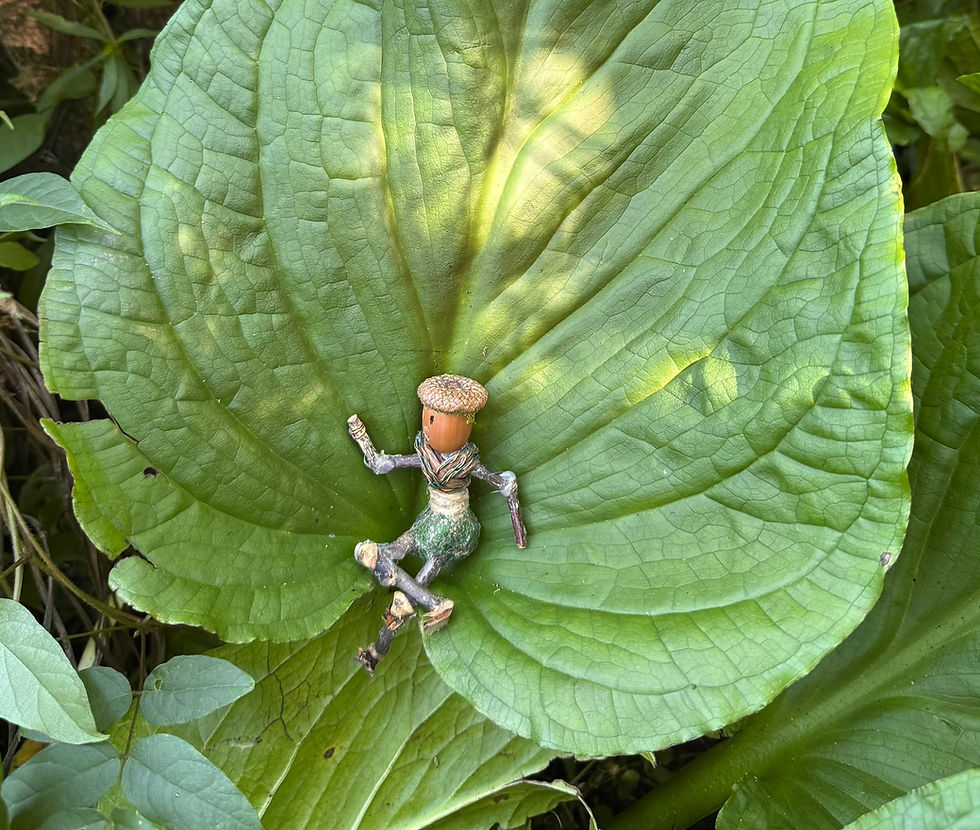
On Today’s episode of Adventures with Gary The Wood Sprite: Season 2, (Spring) episode 13 (Grant Park). It’s May 29, 2026. We started at the Kenard Nature Nook parking lot at Grant Park in Washington Township, OH. From there we took the paved loop trail. This was my very first-time sitting on a statue! Yay!
Grant Park is managed by the Centerville-Washington Park District that serves both the City of Centerville and Washington Township, Ohio. There are 51 parks across Centerville and Washington Township, Ohio, encompassing more than 1,000 acres.
This park has a lot of organizations involved. There are four different groups represented inside of one small area. This is clearly at well loved, well-funded and favorite place of the locals.
First let’s review the 2 buildings:
The brown building off the parking lot is the Kennard Nature Nook. It’s used for indoor park district nature and recreation programs. Also, it can be reserved for free for nonprofit organizations and for a fee for residents.
The big white barn also off the parking lot was originally built as a functional agricultural building for Normandy Farms, a massive 700-acre country estate and commercial dairy farm established by General Motors executive Richard H. Grant in the 1920s. Today it functions strictly as a storage facility for park maintenance equipment and tools used by the Centerville-Washington Park District. If you plan to take professional photos at the barn, the Centerville-Washington Park District (CWPD) requires a commercial photography permit.
Next, we review the various points of interest:
First:
There is a placard and a peace pole added by the Rotary Club of Centerville. It’s a local chapter of Rotary International, which is a worldwide service organization made up of professionals, community leaders, and volunteers who do community service projects and run fundraisers. It was founded in 1905 and had a rotating meeting location (hence the name “Rotary”) because members would meet at each other’s offices. I thought the peace pole was fascinating especially the Hindu text.
Second:
There is a white sign on a post with a phone bracket on top with CWD-101 on it. Chronolog is a community-science platform that creates crowdsourced environmental time-lapse records. Visitors take photos from the same spot over time, upload them, and Chronolog combines them into a time-lapse showing how the landscape changes. Neat! I had never seen this before. I watched the time lapse online it was so interesting to see it change over the last three years.
Here in lies the lesson in this post: Read the signage. Slow down and read. I usually am too excited to slow down to read but if I hadn’t read this one, I would have missed the cool time lapse video.
Third:
I saw a sign with a cartoon owl. Its Owlexander, the Centerville-Washington Park District mascot, He is adorable.
Fourth:
We saw many numbered eastern bluebird boxes with a with a wire mesh on the entrance to keep out predators like snakes. One bluebird flew out as we got nearby. They have great color.
Fifth:
This park has access to Holes Creek and I got to play in the sandbar. It felt so soft and squishy. Streams are made up of repeating sequences of features shaped by water flow and geography. Aside from riffles and runs, the most common features are pools, glides, cascades, rapids, and waterfalls. There is no official or scientific difference between a stream and a creek. Both describe fresh water flowing downhill. Generally, "creek" implies a smaller, shallower tributary, while "stream" is a broader, medium-sized term used for any flowing body of water.
The creek was the only place I found trash. At first, I found what I thought was snake skin but it’s actually dirty plastic bubble wrap. I also found a broken piece of clear glass (thus important for humans to wear shoes in creeks).
Sixth:
See the sign that says H2Ohio? Did you know that the State of Ohio has its own EPA? H2Ohio is a partnership between multiple state agencies, including the Ohio EPA. It is a statewide Ohio program that often funds environmental work in streams and watersheds like Holes Creek. It’s aimed at reducing runoff impacts from nearby development (roads, neighborhoods, lawns) while improving water quality downstream in the Great Miami River system.
Seventh:
See the tree with a green bag around the bottom? It holds water and slowly releases it through tiny holes at the bottom. (another clue as to how well loved and cared for this place is). The black mesh guard protects the young trunk from rodents, deer, and weed-whacker damage. The wooden stakes provide physical support to keep the unstable young tree upright.
Eighth:
I promised I would notice the clouds from the Daniels peace post (S2E11). So here is the cloud breakdown: there were high-level cirrus clouds and linear contrails.
Ninth:
There is a nature play place where moving sticks around is encouraged. This is unlike at Kiser Lake in S1E3 where kids built a lean to (still neat though).
Tenth:
A wonderfully clean drinking fountain with delicious water.
Eleventh:
Statues of cute children playing. The girl was my favorite.
Twelfth:
A screech owl nest box. There is no perch to keep predators from landing and the hole is 3 inches specifically made for the screech owl.
Now on to the plants!
What is a weed? A weed is any plant growing in an unwanted location.
A noxious weed is a legal designation given to any plant that is injurious to public health, agriculture, recreation, wildlife, or property.
All noxious weeds are invasive, but not all invasive weeds are noxious. Curly dock (see the pic for tall green popcorn looking plant) for example contains soluble oxalates. If eaten in massive quantities by cattle, sheep, or horses, it binds to their calcium, potentially causing muscle tremors, kidney damage, or metabolic issues. So, it’s a good thing this meadow isn’t for cows.
The pink flower is crown vetch and not red clover. They look alike. Crown vetch is bad for horses and chickens. Again, good thing no animals in this field. Its legally considered noxious in Minnesota and Indiana and is illegal to sell, import or transport but not Ohio.
Unlike invasive plants, which must be non-native, aggressive plants can be native or non-native.
Confused yet?
How are native vs nonnative plant designations decided?
Scientists use a historical cutoff date to draw the line between native and non-native. In North America: The standard benchmark is prior to European settlement (roughly around the year 1492 or 1500). If a plant was already flourishing in a region before European ships arrived with foreign seeds, it is recognized as native.
What are those pokey, pointy brown spheres/cones on a stick? Teasel!
Do you know the difference between a thistle and a teasel?
Thistles and teasels look alike so it’s confusing. Teasels have large heads of small purple flowers and are plants that look ferocious with spines. The teasel itself got its name because the flower heads were used to tease out the wool before spinning (carding). The teasels have lots of sharp parts in the actual flower head, so the flower head looks like a spiny ball the whole season. The plant that is cupping water is the new growth of the teasel.
In thistles, the bracts below the flower stays, but there are no persistent spiny parts inside among the flowers themselves. So, it looks like it’s wearing a purple hat. Like me sort of!
Do you know the difference between a prairie and a meadow? A prairie is widespread, low-maintenance and self-sustaining. A meadow is smaller and requires active human intervention (mowing, grazing, or scything) to prevent woody shrubs and trees from taking over. It will transition to a forest if left alone.
See the green plant that looks like it holding an umbrella? That is black snake root. Do you know the difference between white snake root and black snake root? In medieval and colonial times, people practiced a philosophy called the Doctrine of Signatures. This was the belief that a plant's physical appearance gave clues about what it could heal. Many "snakeroots" have thick, twisting, fibrous root systems that physically resemble a tangled mass of snakes. It was believed that the roots of these plants could cure venomous snakebites. Both have white flowers but they are clustered in different shapes. Black Snakeroot and White Snakeroot are not related at all.
The other plants are: Spreading Chervil (not carrot), Cottonwood tree (that’s all the white fluffy seeds), Japanese Chess, Cudweed, Honey Locust, Black Tupelo (the tree with the green bag), Bittersweet Nightshade (purple and yellow flower), Black Locust tree, Sycamore tree, Eastern Redbud tree, Yellow Sweet Clover and Orange Coneflower.
When you go to a park do you slow down and read the signs? What percentage of people do in your opinion?


Comments